
Interoperability isn't a differentiator. It's a prerequisite.
And in the new market taking shape around Brazil's Duplicata Escritural — the country's move to fully electronic trade receivables — that's no longer a talking point. It's an operational requirement for any system that wants to take part.
What interoperability really means (no buzzwords)
In tech, "interoperability" usually ends up as a line on a sales slide. In practice, it's simple: it's the ability of different systems — built by different companies, at different times, never designed to work together — to exchange data reliably, with no manual rework and no ambiguity.
Why Duplicata Escritural makes interoperability mandatory
In this market, interoperability stopped being an architecture choice. It became an operational requirement.
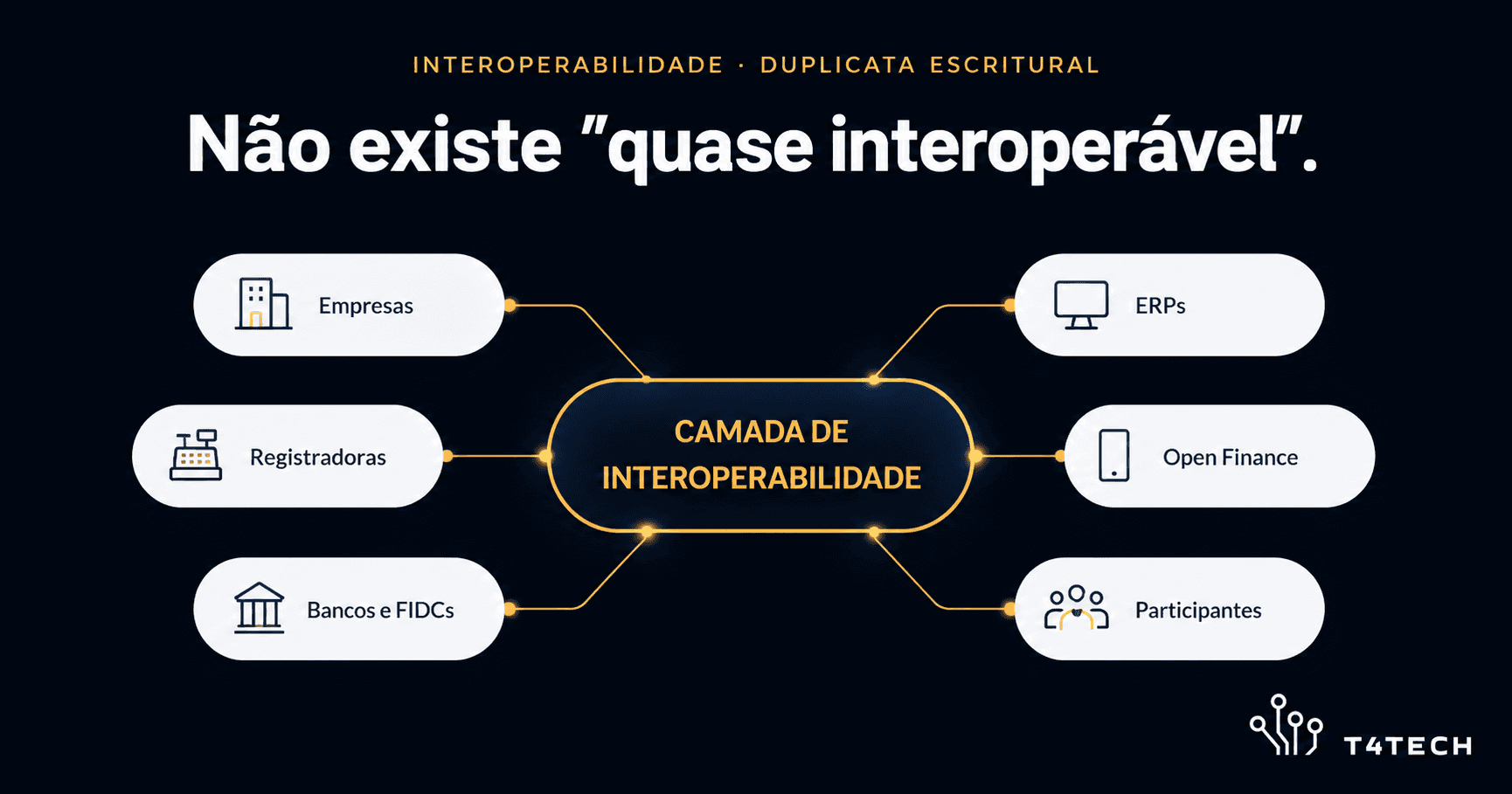
The model defined by Brazil's Central Bank assumes multiple registrars, multiple financial institutions and multiple participants operating on the same receivable, at the same time, with end-to-end data integrity. There is no such thing as "almost interoperable." Either a system talks to the ecosystem as a whole, or it becomes one more point of friction in a market created precisely to remove it.
That ecosystem already has concrete players. Today there are four authorized registrars — B3, CERC, Núclea and Grafeno — and the rule is strict: a receivable that isn't registered can't be used as loan collateral. Adoption is phased: 2026 is the assisted-production year, and full mandatory adoption rolls out by company size between 2027 and 2028. In other words, the number of systems that need to talk to each other only grows — and every poorly solved integration turns into friction in a market designed to eliminate it.
Real interoperability is built from the first requirement
At T4Tech, this isn't a new idea for us. It's the problem we've been solving for years — connecting ticketing platforms, multi-source data pipelines and banking cores that were never designed to talk to each other. It's the same logic we applied when we built the SSO that unified access to every application of one of the world's largest sports organizations, bringing distinct systems under a single authentication and identity layer. The lesson: real interoperability is built by thinking about the ecosystem from the very first requirement — not as a translation layer bolted on afterwards.
We're following this new receivables framework closely, and we're already working on solutions for this emerging market.
Frequently asked questions
What is Duplicata Escritural?
It's the fully digital version of the Brazilian trade receivable (duplicata): issuance, registration, acceptance and assignment become electronic and registered, coordinated by Brazil's Central Bank. A registered receivable can be used as loan collateral; an unregistered one cannot.
Why is interoperability mandatory in this market?
Because the model assumes several participants — companies, banks, registrars and investment funds — operating on the same receivable at the same time. Without reliable data exchange across all of them, a system becomes a point of friction, the opposite of what the framework is meant to achieve.
What are the registrars?
They are the entities authorized to register receivables. There are currently four: B3, CERC, Núclea and Grafeno. Any participating system has to be able to operate with them.
What does "no such thing as almost interoperable" mean?
It means there's no middle ground. An integration that works with one registrar or institution and fails with another is, for the participant on the other side, simply broken. Either the system talks to the entire ecosystem, or it creates friction.
Does your operation depend on exchanging data across multiple participants?
If it does, let's talk.

