

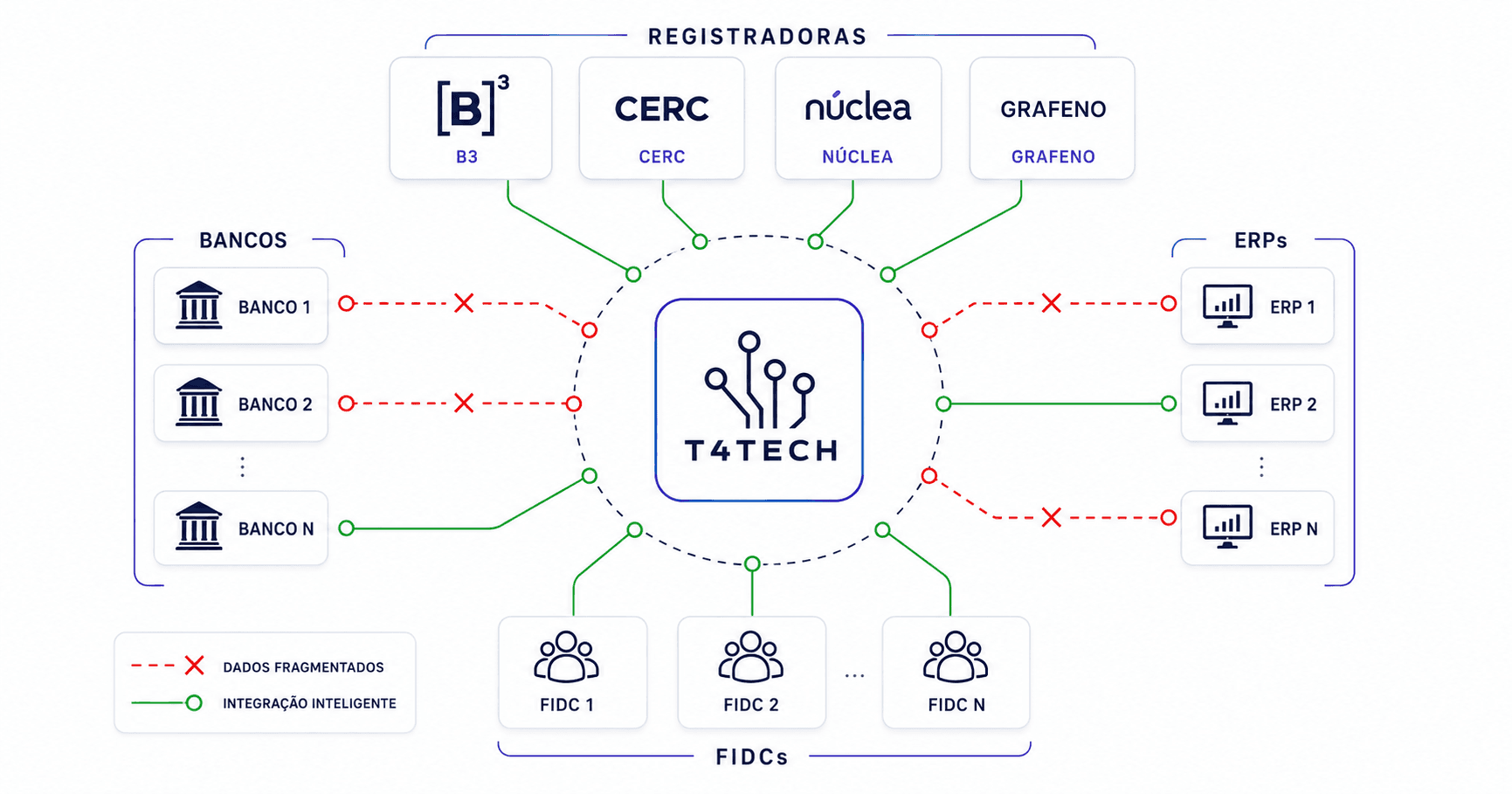
The receivables market has a real challenge: every company speaks a different language.
Banks, companies, registrars, investment funds and ERPs. Each has its own system, its own rules and its own way of exchanging information. In the end, everyone focuses on solving their own side and few look at the whole. And it's precisely in that "whole" that the market gets stuck.
A market where each participant speaks its own language
This fragmentation isn't a technical detail: it decides who gets credit, at what price and how fast. While each participant optimizes only its own piece, information gets lost at the boundaries and the cost of that loss lands on whoever needs to advance a receivable.
With Duplicata Escritural, it becomes even more obvious
(For readers outside Brazil: Duplicata Escritural is Brazil's shift to fully electronic, registered trade receivables, coordinated by the Central Bank.)
With it, this reality becomes even more visible. There are several registrars: B3, CERC, Núclea and Grafeno, different integrations, and an enormous volume of data flowing all the time.
And here's the point most people miss: the challenge isn't the regulation itself. It's making all of this talk to each other. The rule opens the market; the hard part is technical, not legal.
Connecting systems is only the beginning
Connecting different systems, making sure the information makes sense, and turning that data into a good credit decision that's where the complexity lives.
Integration is the entry point, not the finish line. Once you've connected, the real work begins: reconciling data from different sources, handling inconsistencies, making sure the same receivable means the same thing everywhere, and keeping all of it traceable and auditable. Without that foundation, "having the data" isn't worth much because data you can't trust doesn't become a decision.
The next step: data that becomes a decision
I believe the next step in this market won't be building yet another integration it will be using this data to make better decisions: faster, safer and at a lower cost.
Credit based on reliable, real-time data changes the game. It changes who gets capital, at what price and at what risk. A small supplier selling to a large company can be assessed on the real context of the operation, not just on its own balance sheet. A decision that used to take days and depended on manual analysis can happen with more speed and less uncertainty.
That's the kind of challenge I like to solve: not adding one more connector to the market, but turning the data that already exists into a better decision.
Frequently asked questions
What's the biggest challenge in the receivables market today?
Not regulation. Fragmentation: many participants (banks, companies, registrars, investment funds, ERPs), each with its own system and format. The challenge is getting them to exchange data reliably.
What changes with Duplicata Escritural?
Receivables become digital and registered, which increases the volume of data and the number of integrations required. That makes interoperability and what you do with the data even more decisive.
What does "turning data into a credit decision" mean?
It means using reliable, real-time information to decide credit approval and pricing with more speed, less risk and lower cost instead of relying on manual analysis and scattered data.
Do you work with credit, technology or integrations in this market?
If your challenge is making systems talk or turning that data into decisions that's exactly the kind of problem T4tech likes to solve. Let's talk.

