

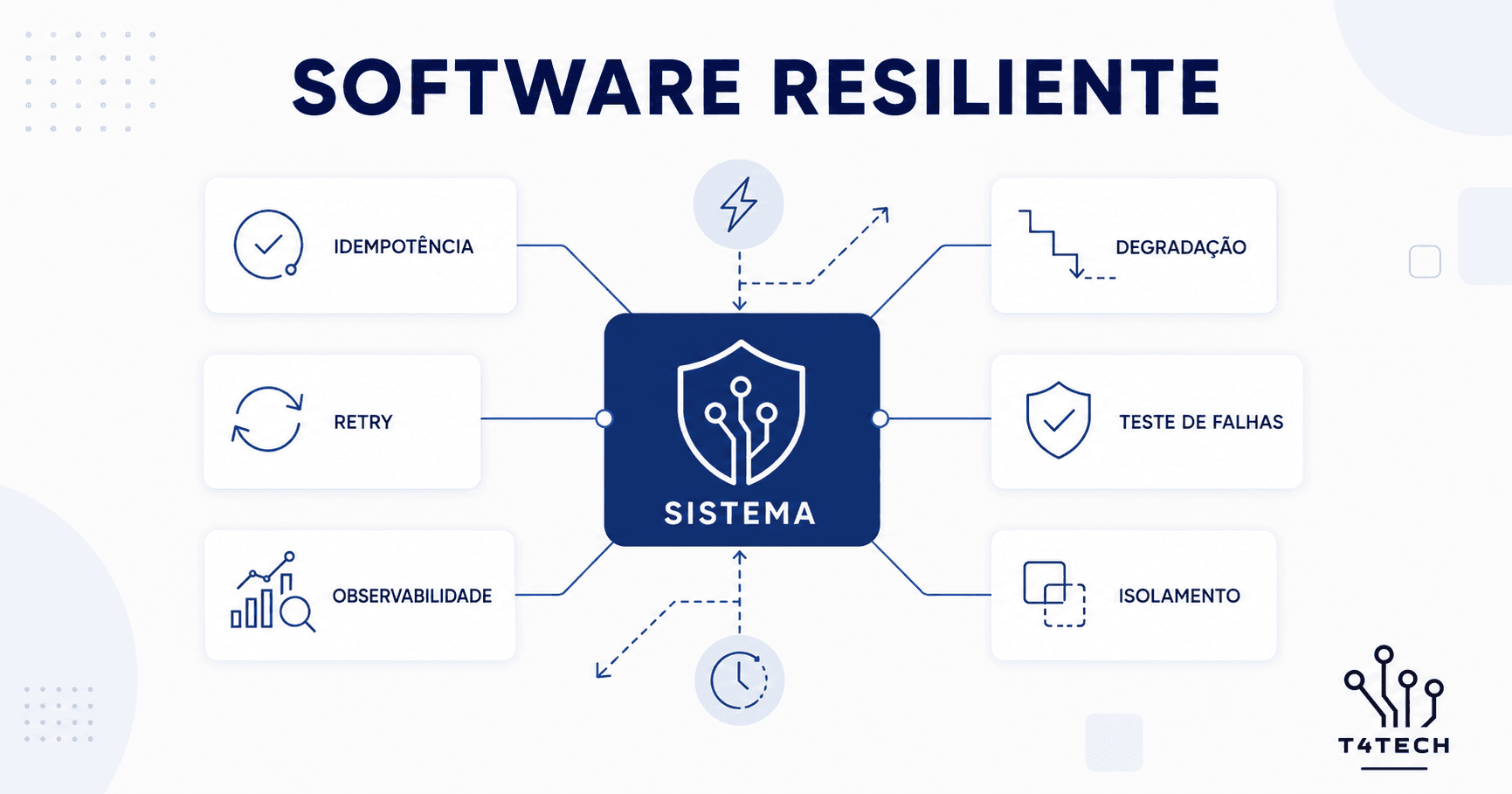
Resilience isn't about never failing. It's about what a system does when failure happens.
After years of integrating systems that were never meant to talk to each other, one thing became clear: timeouts, retries and duplicate webhooks aren't exceptions. They're the expected behavior of any distributed system in production. That's why resilient software isn't an architectural luxury — it's what separates a system that survives the real world from one that only worked in the demo.
Here are five practices I consider non-negotiable for anyone building software that has to withstand real load, not just the test environment.
The reality: every system in production will fail
It's not pessimism, it's statistics. In production, sooner or later:
- the network drops;
- a timeout happens;
- an external dependency goes down;
- a webhook arrives twice.
This isn't a hypothesis. It's the daily reality of any distributed system. Designing on the assumption that "everything will be fine" really means outsourcing the problem for your customer to discover.
What actually sets a resilient system apart
The difference isn't in avoiding failure. It's in how the system behaves when failure happens. A resilient system absorbs the error, recovers and stays consistent — without the user noticing, or noticing as little as possible. The five practices below are how you get there.
1. Idempotency by default
If your integration assumes every call arrives exactly once, it will break. It's a matter of when, not if.
Timeouts, retries and webhook redeliveries make the same message arrive more than once. Idempotency is the guarantee that processing the same message twice has the same effect as processing it once. In practice: use an idempotency key (a unique identifier for the operation), record what has already been processed, and if the same event comes back, respond with success without repeating the effect.
Without it, a simple retry turns into a double charge or a double credit — the kind of bug that costs real money.
2. Retry with judgment
Retry helps. Naive retry destroys.
Retrying with no backoff and no limit doesn't fix instability — it turns a localized hiccup into a system-wide overload. It's the thundering-herd effect: everyone retrying at the same time, finishing off the dependency that was already struggling.
Doing it right takes three things: exponential backoff with jitter (spacing out attempts, with randomness so clients don't sync up), a retry limit, and a circuit breaker that stops hammering a dependency that's already down. And always remember: retry is for transient failures, not permanent errors.
3. Observability from day one
You can't handle what you can't see. Logs, metrics and tracing aren't a luxury — they're a prerequisite.
Three pillars that complement each other: logs tell you what happened, metrics tell you how much and how often, and distributed tracing shows the path of a request as it crosses several services. Add alerts that fire before the customer notices, and you have the difference between catching a problem on your dashboard or on the phone at 3 a.m.
Observability bolted on later is always worse — and more expensive — than observability designed in from the start.
4. Design for degradation
A resilient system knows how to run in reduced mode. When a dependency goes down, it doesn't go down with it — it degrades gracefully.
That means deciding, on purpose, what to sacrifice so the core keeps running: serving data from a cache, switching off a secondary feature behind a feature flag, queuing what can wait. The user might lose a minor feature, but the essentials keep working. Degrading in a controlled way beats going down entirely.
5. Test failure on purpose
If the first network failure your system ever sees happens in production, you didn't test the system. You tested your luck.
Failure is a test scenario, not a surprise. Fault injection and chaos engineering — taking down a dependency on purpose, injecting latency, killing an instance — reveal how the system behaves under adverse conditions before your customer finds out for you. Testing the happy path is easy; resilience is proven by testing the unhappy one — ideally in a controlled environment, before it shows up on its own at the worst possible moment.
Resilience doesn't show up in the demo
This is the point that ties it all together. Resilience doesn't show up in the demo. It shows up months later, under real production load — at the moment when "just restart it" stops being a solution.
That's why these five practices aren't architectural decoration. They're what keeps a system consistent when something goes wrong — and in production, something always goes wrong.
Frequently asked questions
What is resilient software?
Software designed to keep working — or recover quickly — when something fails: the network, an external dependency, a load spike. The goal isn't to avoid every failure, but to control how the system behaves when one happens.
What is idempotency?
It's the guarantee that processing the same operation more than once produces the same result as processing it once. It's essential in distributed systems, because retries and message redeliveries make the same request arrive repeatedly.
Does retry always help?
No. Retrying with no backoff and no limit can make things worse, turning a localized failure into an overload. Safe retry requires exponential backoff with jitter, a retry limit and a circuit breaker.
What is chaos engineering?
It's the practice of deliberately injecting failures into a system — in a controlled way — to learn how it behaves under adverse conditions before those conditions show up on their own in production.
Does your operation depend on software that can't go down?
At T4Tech, we build integrations and systems designed for the real world from the very first requirement — not for the test environment. If your operation depends on software that has to withstand real load, let's talk.

